Pages

Thursday, July 24, 2014

More treats in Panama, and mucho mas molas

Leaving Bocas all I could think about was getting to the San Blas archipeligo and the tribal islands of Kuna Yala. Like Cuba it had become a key destination on my shakedown in the Caribbean.
But even en route there were wonderful places to explore, especially the Rio Chagris River, Portobello and Ilsa Grande.

Rio Chagris is the river just north of Colon and the Atlantic entrance to the Panama Canal. It required a bit of daring-do to cross the bar in rough conditions, which wasn't helped by the sight of bleached broken yachts on the shoreline just at the point of no return.
The river was dammed to create Lake Gatun – a major chunk of the Panama isthmus crossing, to supply the water for the canal locks, and produce the hydro power for all the canal's operational needs.
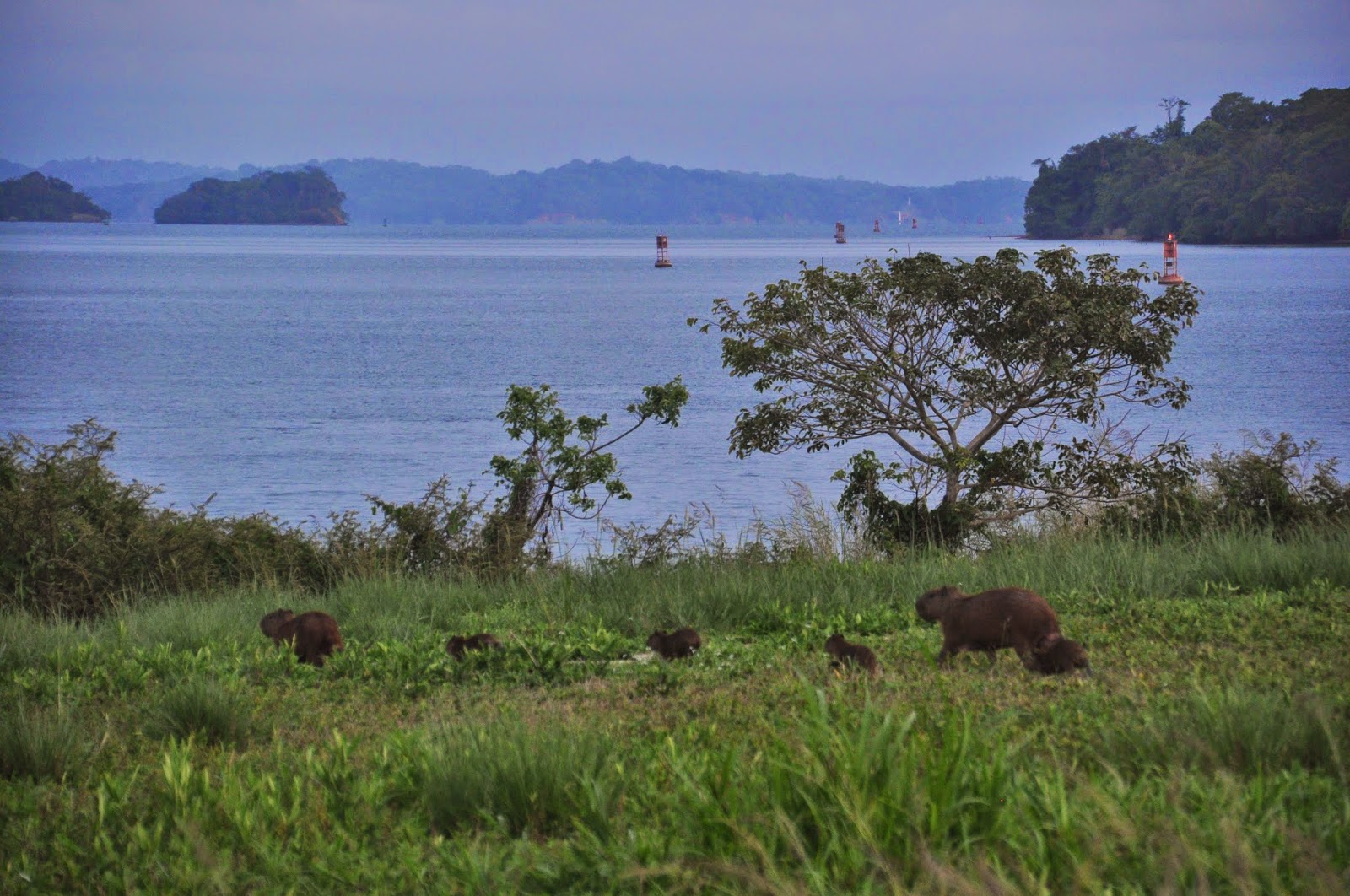
Reminiscent of motor sailing up the Rio Dulce in Guatemala, this was an exquisite way to have a sneak preview of the canal transit ahead of me. But also to experience true Panamanian tropical rainforest in complete isolation., punctuated by the spine-tingling chorus of Howler monkeys and deafening thunderclaps.


Apparently the authorities now send a patrol boat to warn cruisers and fishermen before they release excess water into the river, but there are quite recent tales of yachts being flushed out to sea when they just - opened the control gates!


Portobello is of course a famous Pirate hole, ruined Spanish Forts, and the home of The Black Christ.
I was shocked when making a night-time arrival how many cruising boats are anchored here (and most of them without working anchor lights!) It's a place to hole up while waiting for a canal transit but it seems many get stuck in this sleepy little backwater. The population is mainly of African roots, and there is a Congo music revival happening right now.


Isla Grande is a convenient overnight anchorage before the Kuna Yala, and it is a delight to visit. Popular with Panamanians for weekend getaways, it is bright and resort-like, no cars, and full of quirky budget establishments.


My plan was to spend ten days cruising the archipelego of San Blas, knowing that would be just scratching the surface as there is “an island for every day of the year”.
After clearing in at Porvenir (the Kuna Yala is an autonomous region within Panama , self-administered by the tribal authorities with each island having its own take on matters) it was a matter of ruthlessly deciding which areas to visit and which to leave out. We chose a circuit of the Chichime/Lemmon Cays, the Western then Eastern Holandes, further east to the Coco Banderos, then inshore to the Mola making islands of Rio Sidra and Mormake Tupu, then into the Gulf of San Blas with the possibility of exploring some of the mainland rivers by dinghy.

The Holandes were my favourite, uncrowded (not many deserted, but often only one or two families resident). The water colours, quality of snorkelling, and regular contact with the Kuna people were all highlights. I don't think the sails were used at all, as there was no wind, and the boat took on a very damp smell. Every anchorage was christened with glorious plunges into the water to wash off the sweat and cool down.
As they say, a picture is worth a thousand words, so check out my photos for a glimpse of life in the Kuna Yalas.


After Mormake Tupu the exposure to never-ending canoes of seafood & vege sellers, mola sellers, et al, and the constant warm damp muggy conditions in this, the rainy season, I didn't feel a need to spend any more time in the Kuna Yala. And the enormous amount of plastic trash and beach litter was a sad reminder that even the best intentions of the Kuna can't protect their islands.


Venancio Restrepo (on right) Master Mola Maker of Mormake Tupu
a lovely gentle man and wonderful artist


Tikal - A Mayan Marvel


 Tikal (tee-KAL) is a ruined Maya city located in the northern Petén province of Guatemala. During the heyday of the Maya Empire, Tikal was a very important and influential city, controlling vast stretches of territory and dominating smaller city-states. Like the rest of the great Maya cities, Tikal fell into decline around 900 A.D. or so and was eventually abandoned. It is currently an important archaeological and tourism site.

We (Jackie and I) visited Tikal from Fronteras, Rio Dulce, leaving Whakaari in the marina district near the bridge. This involved a 4-5 hour drive across rural Guatemala to Parque Nacional Tikal on easter Weekend which was fascinating -they go crazy about their easter celebrations. We stayed two nights at Jungle Lodge, and had booked a guide for a full day, as well as a night tour with one of the guards, and a pre-dawn visit in time to be up on Temple 4 for sunrise over Tikal. So we really had ample time to properly experience this awesome World Heritage Site.
I hope my photos give some idea of how extensive this site is, and how imposing most of the temples are. I've included a summary of the history below - If you want to know more, go to:

http://latinamericanhistory.about.com/od/Maya/p/The-History-Of-Tikal.htm


Early History at Tikal
Archaeological records near Tikal go back to about 1000 B.C. and by 300 B.C. or so it was already a thriving city. By the Mayan Classic Era (roughly 300 A.D.) it was an important urban center, thriving as other nearby cities declined.
When Tikal was at its peak its population was estimated to be around 11,000 in the city center and 40,000 in the surrounding areas. At the dawn of the Maya Classic era, Tikal was one of the most important cities in the Maya region. In 378 Tikal was the dominant city in the region, controlling several other smaller city-states. Warfare was common, and sometime in the late sixth century, Tikal was defeated by Calakmul, Caracol, or a combination of the two, causing a gap in the city’s prominence and historical records. Tikal bounced back, however, once again becoming a great power.

 The Decline of Tikal
 The Mayan civilisation began to crumble around 700 A.D. and by 900 A.D. or so it was a shadow of its former self.   Historians disagree on why the Maya civilization collapsed: it may have been due to famine, disease, warfare, climate change or any combination of those factors. Tikal, too, declined: the last recorded date on a Tikal monument is 869 A.D. and historians think that by 950 A.D. the city was essentially abandoned.

Rediscovery and Restoration
Tikal was never completely "lost:" locals always knew of the city throughout the colonial and republican eras. Travelers occasionally visited, such as John Lloyd Stephens in the 1840's, but Tikal's remoteness (getting there entailed several days' trek through steamy jungles) kept most visitors away. The first archaeological teams arrived in the 1880's, but it wasn't until an airstrip was built in the early 1950's that archaeology and study of the site began in earnest. In 1955, the University of Pennsylvania began a long project at Tikal: they remained until 1969 when the Guatemalan government began research there.

Tikal Today
Decades of archaeological work have uncovered most of the major buildings, although a good portion of the original city is still awaiting excavation. There are many pyramids, temples and palaces for exploring. Highlights include the Plaza of Seven Temples, the Palace at the Central Acropolis and the Lost World complex.
Tikal is one of Gautemala's most important tourism sites . Tikal National Park, which includes the archaeological complex and the surrounding rainforest, is a UNESCO World Heritage Site, and a much greater area surrounding the park is now a Biosphere reserve.

Wednesday, July 16, 2014

Bocas del Toro

Oh How I Love Bocas!

A magic sail from Providencia to the cruising grounds of Bocas del Toro, 250 nm away at the northern end of Panama in the south west Caribbean, had me full of expectation and I  wasn't to be disappointed.

It took a bit to recover from the boarding party of Panamanian officials, who not only needed more copies of everything than I've ever been asked for, but also needed more money off me than any other country on my journey so far-nearly US$500. Much cheaper to come the other way and enter at Panama City - only $50. Go figure!
But Bocas Town was a lively place, and though covered in litter and piles of trash on every corner, it has some great things going for it. The buildings are all wooden, with a quaint Victorian feel. Backpackers throng there for the cheap resorts, Spanish language schools, diving (the main tourism industry) surfing and beaches. Its also close to the mountains and rainforests of the mainland, including well known backpacker destinations like Boquette and Volcan Baru. Bocas has cuisine to suit all tastes, wifi and live music everywhere. The provisioning options are good too, with lots of Chinese owned supermarkets, and cheap fresh fruit & veges at street vendor stalls.

But the best places were a short boat trip away – Cayo Caranero, Isla Bastimentos, and some isolated places like Dolphin Bay.
It rained heavily for a lot of the time (good to top up with fresh rainwater for drinking) but apart from spending more time & money at bars on $1 beers waiting for the downpours to ease it didn't interfer with doing stuff – like paddling up Salt Creek to it's end where you can hike further to explore a bat cave, walking over Isla Bastimentos to Wizard Beach and Red Frog Beach, and sailing to Dolphin Bay via tight mangrove waterways to join a Sunday pizza party at an Austrian owned retreat called Rana Azul (Blue Frog).

There were plenty of expats making an income, and enjoying a good lifestyle in and around Bocas, from accommodation lodges to charter operations. Land is available without too many complications to purchase, as long as you don't end up buying something thats being sold to several people at once. There are no hurricanes, and tourism goes on all year round. The cruising is fabulous as there are short distances to varied destinations where there are activities before returning to Bocas. Tempting!


Wizard Beach

Free Range Cattle at Wizards

Big Buddha or a Monkey God??

Tent Platform at Rana Azul for Woofas and Guests

Another Heliconia?

Best Friends

Rana Azul makes an appearance


Bocas Waterfront Restaurants

Axel enjoying some young backpacker company


Cacao

A hour loop walk above Rana Azul with a Volunteer Guide ( he turned up from the village
that  the Austrian-owned retreat provides work for)

Bastimentos

Bastimentos Bar -looking for Oscar to take us caving but he'd moved on

Bastimentos Hammock Platform

Watching a local soccer game


On the hill above Bastimentos village is this amazing shop and cafe specializing in
handmade chocolate from local cacao - owned and run by an Irish woman

Wizard Beach -swim time!


Salt Creek and another volunteer guide. It was low tide
so I had help him get that heavy hardwood cayuco into the stream.
He showed me how to do a perfecr J-stroke,and stood up to show he could SUP as well. They usually paddle seated

Cave formations. Unfortunately my bat pics didn't come out but there were thousands of them,
and great mounds of bat shit of course!


Well, you have to do it, even if its just a little jump

Three Toed Sloth en route to the cave


Stunning roots of a swamp forest on Cayo Cabonero

Another meal aboard from local produce -pescado (a yellowtail I caught off the Zapatilla Cays)
sweet potato and a tomato & cucmber salad