Pages

Sunday, May 25, 2014

Viva Cuba! Part 2


Captain's Log 05 March 2014 @ 0600 hrs
Whakaari slipped out of Santiago de Cuba with three souls aboard, under the ever watchful presence of Fort El Morro, its ramparts bristling with cannons.
Rory, Lizzie and I were bound for new adventures along the south coast of Cuba with 3 days to cover the territory to Manzanillo where Annika was supposed to join us.

One refreshing aspect of sailing in Cuba after 6 weeks in the Bahamas is the topography -hills at last, and not just small hills – Cuba's tallest peaks are on the southern ranges, particularly the Sierra Maestra, the highest being Pico Turquino at 1972m. Not only is the scenery dramatic but sailors benefit from katabatic winds flowing down to sea level, countering the eastward current. We flew the assymetrical spinnaker a lot along this coastline, in good depths (another nice change from the Bahamas!) allowing us to sail close to shore.

Siesta time in Manzanillo 
The south coast has very few marinas so the Frontera has to accept that boats will be anchoring which means fewer boardings and paperwork as well as a chance to interact with the friendly locals in small undeveloped towns. We stayed in Maria de Portillo ( a night entry with no beacons) and Cabo Cruz (in the lee of an offshore reef, anchored some 4 miles off the coast) and both times enjoyed meeting local villagers, trading grease to repair a bore pump, fishing nylon and hooks for a big fresh fish, or t-shirts for lobsters. I never felt that we, my yacht or tender were threatened.

Fidel Castro and Che Guevarra are constant images whereever one goes in Cuba, and their legendary exploits were laying down a path for us. Santiago de Cuba was the site of Fidel's failed attack on the Moncado Barracks in 1953, as he set about toppling Batista the puppet dictator. Cayo Granma gave her name to the boat Fidel and Che would use to transport their small revolutionist army, and soon we would be anchored at Los Colorados where they were ambushed as they landed, losing most of the 81 men and the rest fleeing into the mangroves and fighting starvation instead. But from these early attempts came huge changes for the people of Cuba.
-A small memorial had been built here but only the foundations were visible under the water. Both Rory and my cameras lost battery power when we arrived on-site by dinghy so no photos were taken. The sombre nature of the place was further reinforced for us soon after as Frontera guards came out to the boat and forced us to anchor further away “for our own good”. However the Playa (beach resort) nearby was busy and I think they feared young Cubans might try to come aboard, as we were told to “have no contact”.

Locals coming to town
Manzanillo was our next port, where Annika would join us, and that became a troubled visit as the Port Captain decided she could not board the yacht and would have to travel back to Ceinfuegos to join there. No amount of discussion or even subtle attempts at bribery, could change his mind. This decision cost us all time, money and lost opportunities, and we later found out that he had no right to prevent her joining the boat. Annika had to ride a bus for another 22  hours and take a cab for 160km (amazingly this only cost US $20).
However, the town was delightful, totally unaffected by tourism, instead reliant on sugar production, dotted with grand colonial buildings, Moorish architecture, and a grand Jose Marti town square where people throng to in the evenings for Salsa dancing.
Siesta brings an odd quietness across the town, but in the early evening everyone is out on the streets enjoying neighbourly meals, games and music, many older men and women are smoking big Cuban cigars, and the horse & cart taxis are everywhere with revellers partying aboard.


There was nothing for it but to make for Ceinfuegos, which we did quickly, covering the 230 nautical miles in 38 hours. We negotiated the 6 mile long harbour approach at midnight, and were just anchoring and hoping for a good rest when the Frontera boat pulled alongside, the Port Captain came aboard and directed us to the dock for immediate processing.
So began two and a half hours of enthusiastic Frontera guards searching the boat with two dogs, detailed recording by two officers of yacht specs I had never been asked for before (mast height, hull construction, engine serial numbers, makes of all electronics on board, etc- I supply most of this on a printed form, with crew list etc, but in every port they insist on handwriting it out themselves in full, questioning the spelling of every word)
The dogs were climbing over the now sleeping forms of Rory and Lizzie, the guards leaning over them to open storage areas, and the cockpit full of officials – all very friendly and just doing their jobs – at two in the morning?!

"Black Pearl" aka Cayman Valhalla 
Ceinfuegos meant shore time, and where Rory and Lizzie would depart for Havana for some Cuban culture then back to New Zealand. For Annika & I it was a good place to leave Whakaari on a safe anchorage and go inland to Trinidad to explore the World Heritage city, and hike into the mountains. But first we soaked up the sights and sounds of Ceinfuegos, Rory and I adding to our Cuban cigar collection along the way.
Our initial dockside mooring was alongside a sinking galleon, not dissimilar to the “Black Pearl”, but her yardarms threatened my rig so we opted for an anchorage instead. This dying ship was a ghostly and foreboding sight in the moonlight. I'm sure her skeleton crew were active while we slept!

Annika flirting with TriniDADians
Trinidad – surely the most beautiful of Cuban towns – was one of the original seven colonial garrison towns built by the Conquistadors, inhabited by rich Spaniards who thrived on its sugarfields worked by slaves. Now its cobbled streets, squeezed between pastel painted three storey mansions, are crowded with vendors making money off the tourists on foot, while big American Chevrolets and Fords of the 50s era grind their way slowly in & out.

Quinteto Cohimbre and guest flautist
Trinidad's restored buildings
 and cobbled streets
Just travelling inland was a treat, crossing many miles at open road speed, watching the landscapes change so quickly, fleeting glimpses of people going about their day. Such a contrast to cruising along at six knots when the view took hours to change.
Our 'casa particular' (like a B&B, but only $20 a room) was in the heart of Trinidad, with a rooftop patio where we could soak up the sounds and smells, and see the mountains where we would soon be hiking. The streets radiated out from the central square, so we just kept walking. Soon all sense of a tourist trap disappeared, and real Cuban life was laid bare before us.


To get to the highlands a car was necessary. Our host had the usual contacts – its all part of making do – and a young trendy man with a 50 year old Russian Lada took us into the Escambray mountains where we would see the second highest peak “el Tope de Collante”, enjoy some fantastic scenery, and a skinny dip at a gorgeous waterfall.


Natural Piscina
Limestone overhang


The trail was a solid four hours return, giving us a good work out. Near the trailhead locals set up stalls outside their homes, or even within the park, selling trail snacks, fresh juices, and fruit.


On the drive out the expected breakdown occurred, and though they work miracles keeping these old cars going, it wasn't to be this time, so our driver arranged a jeep ride back to town. In hindsight it was a miracle that car coped with the hills, especially the downhill bits! A good driver thankfully.

Our last experience in Ceinfuegos was the modern ballet “Possibly Impossible” at the restored 19th Century Tomas Terry theatre, at nine pm. The building is a delight, but the quality performance was even more so. Visitors pay 10x the local price but that still was only $10 for a show of international standard.
We walked back to the boat along the malecon (seawall) where all the young Cubans party and strut their stuff, past the stunning 1920's yacht club, collected our zarpe from the Port Captain and were soon making the run out to sea, past the huge “Bienvenidos to Socialist Cuba”, and on our way to Cayo Largo and then Isla de Juventud, the Island of Youth.

Cayo Largo was a paradox, no Cubans live there but commute to service the tourist resorts, all are foreign owned (German, Italian, French) and all-inclusive , yet there seems very little that speaks of Cuba.
We met up with the young cruisers on 'Libertad' we'd met in Santiago de Cuba, sponging their way at these resorts. They spent every night partying for free at a resort as if they were guests, sleeping the day away then hitting the next resort that wasn't onto them. It could've been anywhere. We enjoyed some gunkholing in the dinghy photographing wildlife, then moved on quickly.

White Heron

Iguana


Isla de Juventud was a highlight of our Cuban visit, a surprise as other cruisers we'd met had said not to waste our time going there. We met some wonderful people, cycled a full day visiting Santa Fe and discovered the rural Cuba. Everyone seemed to have meaningful employment, tending crops and livestock. While cycle touring, 60 miles or more, we passed half a dozen unfinished communist-style high-rise housing complexes that were intended by the Castro regime to support intensive farming operations. They seemed to be sitting waiting for completion and the locals were keeping up the maintenance on the fencing and irrigation systems -waiting for markets to open up?

Our cycle trip in the heat was becoming exhausting, the deteriorating roads wearing us down, when we chanced upon a farm homestead where we were welcomed and given beautiful bore water and shown a rideable foot track that saved us tens of miles. Our offer of money was refused-they had everything they needed.

After some tricky footwork by a german expat taxi driver, known to locals as “The German” Annika obtained a seat on a 'fully booked' flight to Havana, and left bound for the Bahamas.
I set sail for Los Morros, the last possible clearing out port before crossing the Yucatan Channel to Mexico.
Single handed sailing is so dreamlike. At times reminding me of quotes by various adventurers of
“long periods of boredom punctuated by moments of sheer terror”, and at other times just pure bliss.
One morning I communed with a huge pod of dolphins, riding the bow as they performed their aquatic and aerial ballet.
I baked banana bread, made numerous sail changes, clicked away on my Nikon, and snatched power naps while the radar and AIS kept a lookout for other vessels.
Making landfall at 0200 hrs at Cabo San Antonio the boom vang broke while fighting the counter currents as the Caribbean Sea squeezed through the entrance to the Gulf of Mexico.

Los Morros is a far flung outpost with spartan facilities, and a nasty concrete pier ready to tear holes in your floating home. A Norther was forecast, making it an even nastier proposition to dock there so after clearing in, I followed another yacht “Quitico” to a hurricane hole in nearby mangrove islets to wait for a weather window for the Yucatan crossing. Kathy & Rob were great company over the next five days as the winds raged, and the mangrove lagoons were perfect for paddleboarding.
One paddling session turned into an all day mission when I became disorientated. I was forced to climb trees, retrace my strokes for many hours, soak my burnt tired muscles in crocodile infested waters, and at times consider overnighting on my board. But thankfully I made it back to Whakaari, sunburnt, dehydrated, scratched up, and completely exhausted.
Ever since that experience I stick a handheld compass on the deck of my SUP, doh!


The day finally arrived for Whakaari to depart Cuban waters, and I cleared out ready for Mexico somewhat anxious after reading all the cautionary tales about the notorious Yucatan Channel. I did score two fantastic langostas (lobsters) for ten bucks from a fisherman at the dock before leaving – dinners en route sorted!

Friday, May 23, 2014

Viva Cuba!


After what seemed like an eternity in blue blue Bahamian waters, it was exciting to clear out of Great Inagua and make for the Windward Passage to Cuba.
Guantanamo Bay was our first taste of USvCuba history -we had a close line along the south coast making for our landfall at Santiago de Cuba and the Americans weren't too impressed with us cutting across their prohibited zone. We were told in strong words to change course til past their little patch of nostalgia -I wanted to ask why they were still there, why was Obama folding on his election promises and weren't the Cubans getting sick of them and their clinging to the past, but Lizzie played it dumb and apologised that we were wayward Kiwis and didn't realise we were too close. I insisted on holding course but a gunboat was dispatched to chase us off, and our game of chicken was very short. So hence Viva Cuba! became our slogan for the next 6 weeks.
Santiago de Cuba was our clearing in port, which we pulled in to at midnite, after sorting fishermen's flourescent fish attracting lights from navigation lights, and thankfully the Fontera were happy to have us rest the night and be boarded in the morning. Well, the first of many sometimes hilarious, sometimes wildly frustrating, sometimes perfectly simple and easy formalities. Its worth describing in a bit of detail: Every port has its own interpretation of clearing in yachts but suffice to say it generally involves about 6 officials accompanied by serious young soldiers in Castro green uniforms, a dog or two, lots of paper and stamps, and taking up 2-3 hours at any time of the day or night. Sometimes all occurs on board in a chaotic bureaucratic melee, sometimes in a spartan office at the marina. You can't leave the boat until all paperwork is in order, CUCs have been paid (Cuban Convertible Dollars, which visitors have to use, not Cuban pesos), and you have received the usual instructions “NOT to patronise Casa Familiars, buy Cuban cigars or rum from street dealers, use drugs, take Cubans aboard, or stay anywhere but a Govt Marina”. The customs man and his dog found a “suspicious substance” deep in my wet locker and we had to go and have it tested, which was a real hoot. There must have been a rat on board in the past to make that fine sawdust.
And its not all bureacracy - the quarantine doctor at Santiaga de Cuba invited us out to dinner and salsa dancing – didn't quite work out as we'd been led to believe but a fun nite all the same, and we had quality time with Cubans.
Live Music Everywhere

It is easy as a yachtista to feel imprisoned in Cuban marinas. I was twice hauled off to the Puerto Capitan's office by a security guard to have him remind me that I couldn't paddleboard outside the boundaries of the marina. In fact there is much more freedom travelling in Cuba by land. You certainly don't get woken in the middle of night to have your papers checked as a landlubber but that happened every night in every anchorage to us, and a few times we were forced to move on, as it was “dangerous for us to stay in a particular bay” The real problem was the fear of Cubans coming aboard and leaving the country by yacht. The one time a young man came aboard to trade his catch with us he was constantly watching for Fonteras coming out but we had such a great encounter, learning about his life, his family, his dreams, and swapping T-shirts for lobster and fish. Two of his mates turned up (this is several miles out from the village when we were anchored in the lee of a long reef, these guys swimming for 6 hours or more, no snorkelling gear, just a steel rod to spear fish. We gave hot chocolate and coffee to warm them up then dinghied them to a hidden coastal drop-off in the dark.

Viva Noel the driver! - now and then you are lucky enough to meet just the right person – someone who makes an experience magical, can cut through the dross and get you just where you want to be, or the things you need but can't explain with 'poco poco espanol', takes you to the most fantastic natural foods restaurant at his mate's place, and his mate turns out to be another magician who can get you the best organic coffee you'll ever taste, catches or grows all the food he puts on your plate, and makes Mageritas to die for, then Noel even turns up in an emergency at midnite and becomes a true hero, staying on task til all is resolved by mid morning, and puts the best Cuban music on your stick as his wife is a Salsa teaches, then just before you leave turns up at the marina with his whole family with gifts because we've made so much use of his resources and tipped him well that he now has enough money to overhaul the engine in his 23 year old Lada that is his taxi. Love ya, Noel!

Speaking of cars – you know Cuba has all the 1950-60's collectibles?! Some are spoiled with garish hand painted coats, others tarted up with shiny magwheels, but mostly they're well cared for and in original condition – just stunning to see not another era of car in a busy but decrepit street, like being in a movie set. And we were often riding in them as taxis. Big bench seats, old leather, rumbling V8, clunky stick shift, insignia atop bonnet looming ahead, chromed wings disappearing behind -mmm, loved it!
Rory arrived in Santiago de Cuba, his very first trip outside NZ! - transited LAX, Mexico City and Havana and arrived in fine form in a non-english speaking communist country carrying booty, a big camera and newby looks – how did he manage that!?

Oh, I could go on about our time in Santiago de Cuba – the impressive Morro Castle guarding the harbour entrance, time spent exploring the mercados, the father of the Cuban revolution Jose Marti's tomb, the best Rum in Cuba, gorgeous young women and their sexy salsa moves to very loud music, run down facilities everywhere including concrete docks that damaged Whakaari's gunwhale in a big wind while I was away, cruisers from Canada, Australia, Sweden and South Africa and their stories, Cayo Granma and its hurricane ravaged town, but there is so much more to write about.

Some cruisers thought Cuba was impoverished, living in the past, and falling apart, and that all Cubans wanted to do was leave.
I saw a country quietly waiting for the US trade embargo to die an overdue death, maintaining what they had as best as they could with the meagre resources available so they could be bought back to life when the markets opened up, keeping the distractions and consumerism & waste of our modern world to the minimum so that the young generation focused on the country's wellbeing, and making life fun in the meantime with music and dancing every night everywhere!


The loss of the Eastern bloc markets with the collapse of USSR etc, the rediculous continuation of the trade embargo by the States has virtually stalled Cuba's development, but you can see everywhere that Castro's vision of a self reliant, agricultural based economy is still being quietly pursued.

And the people are strong, happy and confident. Every person I asked had no desire to leave Cuba, tho clearly they do leave, to Miami especially, and of course we still hear about the “wet foot – dry foot” reference to refugees coming ashore in Florida.
Their health services are amazing, with modern medicine practice being the norm, and education for the children is clearly a huge priority. But there is little money, and wages are pitiful. A busy GP can expect to earn the equivalent of US$40, and there are few big income jobs – its a flat structure to ensure everyone can get by, regardless of their trade or profession. A new car is virtually out of the question for 99% of Cubans.
It all works just fine
There are no modern communications that we take for granted.- iPhones? What are they? Every frontera official would ask if I had any broken electronics to give away, so they could break them down for parts, or repair them for their children.
And the Communist regime continues to block such things as Hotmail, Facebook, Google, and will not allow banks to accept American credit cards.
But where there is opportunity, someone will find a way to benefit, and occasionally you would see some pretty impressive bling, esp. amongst the young party people out on the town – the occasional android phone, some big name fashion labels, a boy racer car, sharp haircuts, gel and jewellery
  • “in Cuba you can get nothing, and everything”
Fresh crushed sugar cane drink on the sidewalk


I experienced a vibrant, proud culture where people were happy, healthy, and getting themselves ready for the new order. I still saw poverty, and idleness, but it was minor given the limits on resources.
Their attitude to Americans generally showed what a dinosaur the US administration is, as Cubans welcome tourists from the States -its the return to the States and treatment by US officials that makes Americans fearful of Cuba, not Cuba itself. The inevitable lifting of the trade embargo will see a rush of tourism development which is already simmering away as Cubans prepare to take advantage of a new wealth. I just hope it doesn't destroy the Cuba I was lucky enough to experience 'before the goldrush'.


In Part 2 of this Cuba blog I'll describe Whakaari's journey along the Southern Coast, time spent in the extreme opposites of Cayo Largo and Isla de Juventud, fantastic time ashore in beautiful Trinidad, and my departure from Los Morros across the Yucatan.


Saturday, April 12, 2014

Bahamian Rhapsody


Another month of shakedown cruising spent moving in slow incremental sailing hops from island to
island, trending south in order to reach Cuba.
Entering Exuma Sound Through Current Cut
Leaving Bimini with Lizzie my stalwart crew, we crossed the Grand Bahama Bank to Eluethera. Those 48 hours would have to be some of the most unusual I've spent cruising thus far – ghosting along in barely 10 feet of aquamarine water, the light changing constantly with the seabed - dark grasses, ominously black coral heads, shimmering white sands and shoals -or was it just a cloud. Many an hour spent on the clipper bow in an almost meditative dreaming.
When it became too dark to read the water we dropped the pick and settled in for the night, in the
middle of an endless sea. Our free time on the banks was spent reading about a colourful history of
pirates and wreckers which added to the wonder of these strange shallows. Well into the afternoon of
the second day we crossed over, into the 'Tongue of the Ocean” and the depths plummeted to 2000' in
moments.
After a snug night in Royal Harbour we called in to Spanish Wells for two days and had our first
experience of getting stuck on a sandbar right in the harbour. The locals enjoyed the show as I rowed
out a line to a pole and winched us off. The locals are apparently of pirate stock, but the language they speak is hardly ooh-aars and the like, in fact its the most weird sounding thing I have heard, to be sure.
Lizzie was keen to add a notch to her navigator's belt and negotiate “The Devils Backbone” across the top of Eleuthera. I begged off and we compromised on employing a pilot, who went ahead in his
Boston Whaler, as I laid down a track for a later return. It is a beautiful but breathless transit through
reefs past stunning white sand beaches, and at times you are within 50 metres of the shore with waves
breaking to the outside. The bleached carcasses of boats on raised coral outcrops are testimony to the
fate of the foolhardy in this place.
Tall Ship in Exuma Sound


Eleuthera, so named for the Lutheran settlers
who sailed here.
 (at the northern end we found Preachers
Cave, where they sheltered after being shipwrecked on the reef at the very end of their journey) is a
long long island stretching to the south, forming barrier to the Atlantic and creating the Exuma Sound.
While Lizzie took a shore break in famous Dunmore Town, Annika flew over from Florida and we set about exploring the island.
We had a gorgeous night at Man Island with a full moon (where we met a young French expat with his motor boat, two dogs and a Go-Pro toting remote control helicopter -not sure if he'll ever send us the aerial video he took of Whakaari) then back around the Devil's Backbone and across to Current Cut to access the Exuma Sound. Current Cut flows at 9 knots so timing your passage with the tide is essential.
Its an exhilarating few minutes, flying thru the gap with sails trimmed and engine on just in case.
Then suddenly its back to focused navigation and reading the water as we entered the Exuma Sound,
and marvelled at the intense colours that would be our normal surroundings for the next week.
The seas were almost flat calm allowing us to come in very close to the cliffs that we planned to deep
water solo. It was easy to drop anchor anywhere and go ashore by dinghy or paddleboard to eyeball
climbs on old limestone platforms of 10metres. Ancient caverns exposed by erosion had left stalactites open to the sea, offering some good free climbing when everywhere else the corals are too sharp and brittle.
The next day brought onshore winds to the climbing walls so we sailed south to Governors Harbour
and after a day of searching, found a rental car. There had been a double funeral and everyone had
converged on Governors Harbour, using up all the cars to do so.
Later we would come back to Stalactite Wall in ideal conditions and have a great session there. But our arrival day was almost done, so we entered another amazing cut through rock and anchored in Hatchet Bay and went ashore for provisions. This little town seemed to be in its last death throws. The dock was a mess of rusted hulks, most businesses were closed, and everywhere the vegetation was taking over, the normally brightly painted houses were peeling & faded. But the people seemed happy, and friendly towards us – children sent to show us the way, a lovely chat with a little girl showing off her new bike, men gathering around the “bar” ( a broken house) smiling their welcome.
New Dinghy Dock for  Hatchett Bay a town that's falling down
Happily we found a rental car with lots of local help.
So we started our highlights of Eleuthera tour, beginning with The Glass Window, a natural land bridge to the north, and ending with getting a tooth extracted in South Palmetto (something I had hoped would bring relief but instead the pain continued as an infection set in, and I wasn't to be free of that discomfort for another 2 weeks)
A highlight was Surfers Beach where they get pipelines forming on both right and left hand breaks, and an annual comp is held there drawing internationals. There's a great resort with cheap rates, and the coastline is gorgeous. No waves on our visit, and a lot of plastic on the beach, but still a lovely place.
Then it was back to drop off the car and prepare for some deep water soloing as the wind had died and the waters the climbing walls would be a mirror.


Old grain silos for a failed beef farm
The island was once destined for great things, in the farming sense, with cattle raising being the dream. But it wasn't to be – now derelict grain silos dot the landscape and are only of use to sailors navigating the coastline.
The population seems to rely on imported goods, with very little food production of their own. I read a two page article in the Eleuthera Times by a protagonist of self sufficiency who pointed out the great potential for agriculture, and the obvious increase in obesity and related health issues created by imported processed foods that had become the normal diet.
We bought some fruit and veges from a roadside stall that turned out to be a local co-operative advocating and demonstrating to locals how good food production was possible even with salty soils and poor water supply.
When the weather improved we sailed north again, eager to do some deep water soloing, and we
weren't disappointed.  Whakaari could be sited right alongside the walls, and we nosed up to each climb in the dinghy and paddleboard.
From up on the cliffs turtles, rays, tarpon and snapper were easily spotted in the crystal clear water,
and tho we knew there was plenty of depth, the clarity of the seabed gave the anticipation of a fall just that little extra edge.
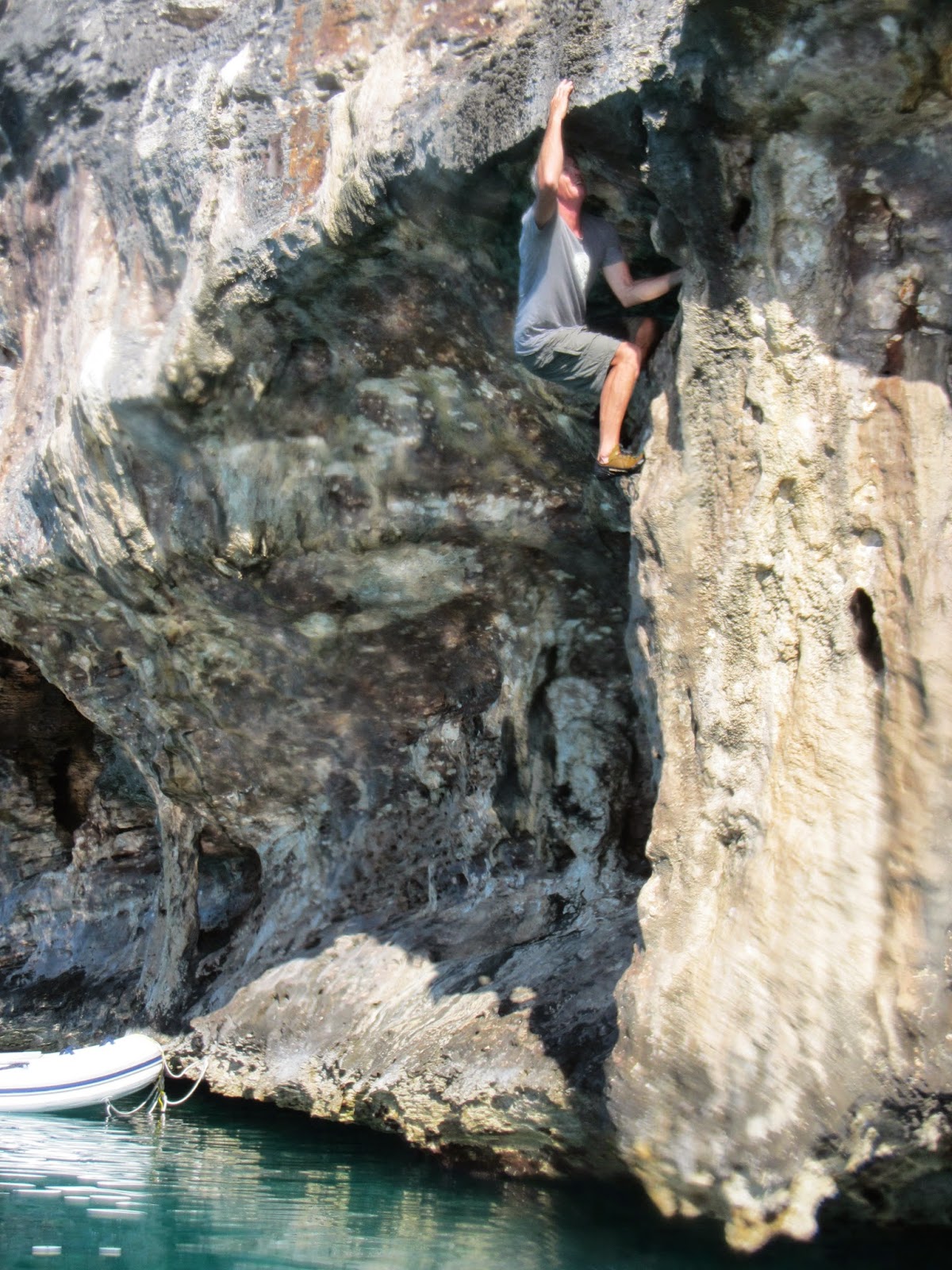
My favourite memory is of a climb on Stalactite Wall. It started from the dinghy into a tight squeeze
then out onto a large column. I worked my way through some tricky moves to position myself under a ledge, then pulled over that easier than I expected. I called out to Annika to get a shot of me, and still enjoying the holds, went for a lunge to finish the climb at 10 metres. Oh no, I missed getting a secure grip and suddenly I was off the wall and shouting out in a curious mix of joy and anticipated shock.
The plunge was so satisfying, but no good for my chalk!
After maxing out the time we had at Stalactite Wall, we had to head for Current Cut to make the tide.
When we went thru, hitting almost 10 knots, we passed Lizzie on a dive boat who was drift diving the
cut, and had three fantastic dives there, seeing sharks and rays in the deep chasm as she glided through.
A third and final time across The Devils Backbone, and we were back at Man Island, and soon at the
end of our Eleuthera Exploration.

So much more to climb!
10-12 metre coral and limestone cliffs of Annies Bight


Annika returned to work, Lizzie wrapped up her shore time, and Whakaari was back in action,
heading out into the Atlantic, and a long run down the Bahamas to Great Inagua where we would clear out of the country. En route we stopped at many beautiful cays, visiting Deans Blue Hole near Clarence Town, Long Cay ( which is the worlds deepest, plunging 202 metres where a fellow Kiwi William Trubridge trains and holds the record for that hole), Little San Salvador (used by Cruise Ships for day visits, so we gunk holed around the estuaries instead) Rum Cay (where we stayed in a derelict marina called Sumner Point, now inhabited by grunge surfer sailors, large nurse sharks and one very intimidating tiger shark)
At Great Inagua, tourists are very rare as the island is fully employed producing salt -Mortens Salt to be precise, and the island is the second largest producer in the world. We witnessed freighters taking on 100 tonnes of salt each as we toured the island with the local park ranger.
Inagua has a resident population of 50,000 West Indian Flamingos, stunningly pink, and over 100
species of other waders, both resident and migrant. The Roseate Spoonbills are awesome to see in
squadron flight. (FYI - The plumage of birds that feed in salt marshes become pink)


Wasting away in Margueritaville
Some people say that there's a woman to blame.......
As has been Whakaari's way, she threw another curly one in Great Inagua, the propane controller going haywire, and leaving us unable to prepare hot food or drink. So I spent a fun half day with the locals finding the necessary bits and pieces to rig a temporary gas supply –Now the only plumber in town would apparently refuse to go out to my boat in a little dinghy as he couldn't swim, but everyone seemed to know that the book keeper for the Salt Company kept a brand new propane regulator in the bottom draw of her filing cabinet! And “Skinny” ,who wasn't, had a surplus 30' line with the exact sized fittings I needed at his workshop and happy to part with it for $80. Job done!


OK, so I staged it

Wednesday, April 2, 2014

Ah, the Everglades -when will they ever end?

What is it about mangroves? people tell you there's hardly any left, but I find them everywhere, so much I get lost in them for days.
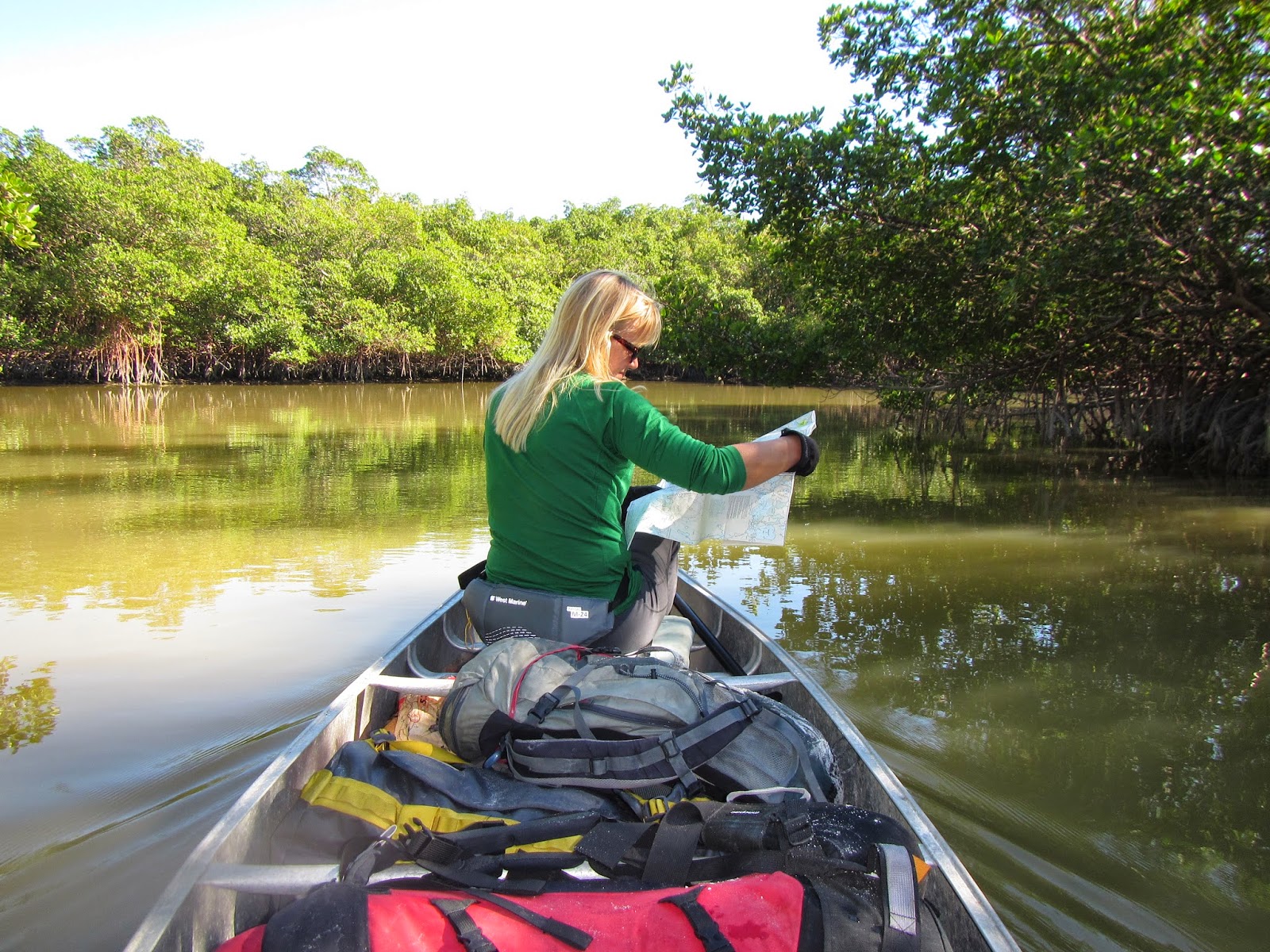
Before leaving Florida for good, Annika and I chose to meet half way between her base of St Petersburg and my pushing off point, Key West, and that took us canoe camping in Everglades National Park on the west coast of the peninsula.


The drive there introduced me to the unusual mix of cypress swamp forest in fresh water flowing out to coastal mangrove estuaries, which we would soon be exploring by canadian canoe, our camping supplies aboard for 4 days of adventure.
( It also took me across large tracts of Indian reservation land, and the not so great revelation that the common notion of casinos and cheap tobacco outlets as "investments" by the tribes, is in fact true. But there was a heathy mix of tourist operations based around airboats, alligator shows, and feather head-dressed characters with chiefly names offering visitors 'Indigenous" cultural experiences.)


The mix of fresh and salt water provides ideal conditions for paddlers to view alligators, wading birds, dolphins, manatees, and osprey.
While the "trails"are accessible year-round, most paddlers attempt them during the winter months when it is cooler and there are less mosquitos - good for us! 
Paddling times vary from two to seven hours depending on winds, tides, paddling speeds, and which trails you choose.

These trails can be difficult for inexperienced paddlers or under certain conditions. Paddling against the tide, fighting a headwind, or being unprepared for the weather or mosquitoes can make for a very strenuous paddle. Well, we chose a longer route for a shorter time, didn't take a compass or GPS, tho they were littering our boats back in their snug harbours. We did take enough water and food to last the distance luckily, as it was hard work, especially out in the Gulf itself where you are more exposed to the conditions.

Our first night was quite special, staying on Sandfly Island due to our late departure, but it meant we had it to ourselves, ( and a few sandflies), and could walk the hour long interpretive trail before setting out the next day. Some would be farmer tried to grow tomatoes there but was driven off by sandflies, drought and hurricanes, doh!
One of the highlights of our trip came early on day two - a large flock of unbelievably white pelicans clustered on a drying shoal and yodelling with their huge floppy pink throats - with the sunlight showing through their skin, it was a sight to behold.
Manatee and alligators were scarce, but herons, cormorants, horseshoe crabs, and Ospreys at every stroke. Even a rabid racoon on a tiny mangrove key, sitting in the water opening mangrove oysters.

The next nights were in the company of other paddlers, and we enjoyed getting to know a group of 6 from way up north who knew their stuff. They'd been in the Everglades for 10 days and keen to get home. Our night with them on the "chickee" , an elevated camping platform, which we presumed were just as necessary to provide somewhere to actually camp in this flooded mangrove wilderness as they were for keeping snakes and alligator out of our beds.


Apart from one anxious "where the Whakaari" when we found ourselves off-trail and dead-ended in a lagoon of herons, and having to retrace our paddle strokes for an hour, we escaped the embarrassment of getting lost ( and the inevitable rescue and questions of why we had no navigational aids) 


The light/water play, sunsets, and sensation of gliding though endless interconnecting channels that flow and ebb was all sublime. Less so the moments when another fisherman in his Boston Whaler came by at speed and swamped us.


It was a well earned beer when we finally paddled back into Everglade City (true name, but more like a back water), and went our separate ways -Annika back to save lives in ICU, and me off to swan around the Grand Bahama Banks


Big In Bimini

Now when someone says to me - I was really outside my comfort zone - all I can think of is a recent dive I made with a Great Hammerhead and several "bad boys from the hood" Bull sharks.
When in South Bimini, entry point for us into the Bahamas, Lizzie & I thought a dive would be great as everything is 'Big in Bimini!" - manta rays, great hammerheads, turtles, but it just so happened that the dive operator had tied himself up with a film crew intent on recording close encounters of the shark kind. So the only choice was to join them, and their crazy burley feeding, shark prodding dive crew. 

After too many uncomfortable  jokes about using me, the newby, as shark bait in we went to have VERY close encounters. Never thought I would enjoy the sensation of a very large shark, mouth open in a kind of threatening smile, brush against my body as it cruised by for another look. The water clarity started out sensationally but soon clouded up as the action of the sharks, us,  the strong current (and reef fish after the burley) stirred up the fine white coral sand. I found myself rubbernecking trying to keep an eye on each of these monsters, but they'd catch me out, cruising past my head, or under my legs, and making my breathing more rapid than it already was. But I went up for another tank and rejoined the crazy film fest for another stint as it was all at once invigorating, beautiful, tantalising, and scary - you find yourself in awe of these graceful and powerful creatures of the blue.

Well as you now know it all ended happily, tho there was one moment when the six Bull Sharks got a bit excited, fighting over a large morsel of bonefish, and our dive master motioned us all up & out. Hate that anxious time of finning back up and climbing the boat ladder when you can't protect your rear!
The marina where we stayed, and the dive operation is based, is one of a growing number in the Bahamas that forbid shark fishing, or bringing caught sharks to their dock, and encourage protection of sharks. There were several huge Nurse Sharks cruising the marina everyday, seemingly quite happy with this notion. And it felt fine to swim off the boat there as well, in their presence.


And talking about BIG - Big news-well, news to me after being awol in Cuba for a month- Japan has finally been forced to stop it's "Scientific Whaling" - great news to big marine creatures everywhere!

Thursday, February 20, 2014

Key West

14 January 2014

Key West - we arrived in fine style flying the huge, new asymmetrical spinnaker and, courtesy of Lizzie, berthing at slip E18 Key West Bight Marina, which would soon be a hive of activity with J class racing yachts and luxury "gin palaces"

So began a long week of living the high life - we cycled the bustling cobbled streets, ate raw seafood every "happy hour" late avo then followed the sounds of live music to the next bar. Sea trials were hardly a trial, especially one sail with Alex and Andrea along the coast and a picnic at anchor on the approach to the AirForce base with F16s and other jets I don't know tilting their wings at us as they lined up for touch & goes.

The locals are an interesting mix. Cubans, Haitians, and Americans from the cold north, misfits from the cities, artisans inspired by the Keys, and tourism cowboys hawking everything from sunset rum cruises to jet ski tours to well worn but well sung covers at every bar on the waterfront. The main street, Duval Street, is the stereotypical tourist hotspot, to be avoided most of the day. Oh, and Roosters! WTF? everywhere, and with no sense of time at all! Cycling is the  way to go in Key West - The mayor is pushing hard with special events, supporter T-shirts, and its obvious - driving a car there must be so frustrating 

"Must do's" would include:
- joining thousands at Mallory Square at Sunset where buskers compete for your dollar and cruise ships leave the wharf just in time for everyone to see the sun set. People actually applaud the sun for setting!?
- visiting Ernest Hemingway's home, overrun with 6 toed "Hemingway cats" , his classic novels  displayed in his study
- having your photo taken at the southernmost point of continental USA  - a simple monolith that is available as a souvenir in every possible way
- eating raw oysters, stone crab claws and conch salad (Key West proudly claims to be the capital of the Conch Republic, they even have their own flag. Conch by the way is pronounced 'Konk', and yes it is that huge colourful shell. As in Marathon,they are blown at sunset, along with the firing of cannons, but here in Key West they're drowned out by the kettle drums and "Sweet Home Alabama" being blasted out from every sunset cruise boat offering as much rum as backpackers can drink for 30 bucks while dancing to the setting sun
- flying by seaplane to the Dry Tortugas to wander round Fort Jefferson and snorkel the small coral heads there
- smoking up big time on Cuban "seed-sourced" cigars and listening to some of the best blues in Florida, and taking in a movie at a classic independent cinema
- taking a guided yoga routine on the beach at sunrise, complete with lavender eye pads while meditating and Namastes all round, sweet as
- diving at Marquesas Keys to explore coral reefs in the middle of nowhere: morays, loggerhead turtles, nurse sharks, mahimahi, huge fans and tubes, nice!

Yep - been there, done all dat but didn't buy the T-shirt, just a few takeaway cigars and some good memories.

It wasn't all play of course, there were more issues to sort, like dealing with Customs and "exporting my boat", replacing the fluxgate compass so the auto pilot actually knew where to go, interfacing the AIS with the chart plotter so I can see ships on a collision course, replacing worn sheets when West Marine had a 40% off sale on rope, sea trialling changes made with wonder kid Alex who drove down from Marathon to see us right.
He and I had been getting frustrated climbing around the big Destroyer wheel that is Whakaari's helm so we started taking it off when working on the boat. Alex reckoned I needed an 'Oh Shit!' wheel in harbour (in case one suddenly had to get out of bed and deal with a dragging anchor, a small car steering wheel-type back-up) and when he and his girl Andrea came down to Key West they gave Whakaari a present -a gorgeous wooden spoked ship's wheel they found at a flea market, just perfect! So it's one of those things I'll really look forward to at the end of a passage - to take off the stainless steel destroyer wheel and fit this lovely high-gloss varnished (by Lizzie) Oh Shit wheel. Thanks Alex and Andrea!
Also thanks again to my crew, Lizzie, and Annika (and her friend Lara from the snows of Minnesota) -great company, good times!

Soon enough it was time to leave the United States of America. On the 27th of January I would be an overstayer, 3 months since my ESTA was initiated, so on 26 Jan Lizzie & I slipped out of Key West at midnite, heading out to the Atlantic and the Gulf Stream.

May your boat be leak free.
May your sails be in good repair.
May the winds be fair, the weather kind and

May your days be filled with the exquisite pleasure of new adventures, fabulous destinations and excellent friendship.


Sunday, January 5, 2014

Pushing Off

Renaming Blessings - My surveyor Lee and his family centre
Xmas arrived and forced me to act - had to push off on Boxing Day and move somewhere before I became stuck fast in Tampa Bay. It had become an almost funny continuum of bad luck and unseen issues - Customs needed me to depart the States at St Petersburg and become an exporter to ship Whakaari out, even tho the next port was still in Florida; The electricians hadn't had time to finish everything before Xmas and I wasn't waiting round for more work in the New Year;  I managed to acquire a raging flu that attacked me with more vigour every day for more than two weeks, the drugs didn't help, and I ended up hacking away trying to direct preparations in between coughing fits; denaming and renaming of Whakaari was squeezed into the pre Xmas chaos and thankfully a great group of people came along for the renaming while Lizzie poured champagne and I beseeched the gods for fair winds and safe passages; my new inflatable dinghy arrived in the 11th hour and once out of its box turned out to be shop damaged so began a full day of haggling to get a replacement shipped down the line; making fitted linen and mattress protectors hadn't been started til Xmas Eve and poor Dianne who'd taken on the task spent her Xmas sewing; destinations south to the Keys were filling up for with the holiday rush and we left without having a mooring or slip to go to. But after a fun Christmas grill by the pool leave we did on Boxing Day nearly 3 hrs later than planned and we slipped the lines well after sunset and headed out into Tampa Bay for the last time.
"Whakaari" - rebirth & rejuvenation

Leaving Tampa Bay - Skyway Bridge
We had a fast reaching sail down from St Petersburg, sharing the watches and revelling in finally getting some sailing. Whakaari had a bone in her mouth the whole way, covering the 240miles in 37 hrs. Wow, is she fast, and a dream to sail - like a racehorse that has had the reins held too tight for too long - just ease sheets and she sets into her groove and pumps along , steady as a rock, at 8 knots - truly exhiliarating, and the wind held all the way, with super clear nights - takes a while to get used to sailing under a northern hemisphere sky - Orion and the Big Dipper sitting above the masthead. And endless lines of crab traps -thankfully Whakaari has a full keel and protected prop and rudder, with a rope cutter on the shaft, so we didn't have to be too concerned. There is no deep water here, quite the opposite to home. I draw 5'8" and having on average 11-12 ' under the keel is normal, 35' a rare relief. 

A membership with BoatUS almost obligatory to get towed off the ubiquitous shallows. We didn't need it, I'm pleased to report.

We sailed most of the way relying on iPhone Navionics as the new Raymarine system fell over completely, not long after clearing the Skyway Bridge exiting Tampa Bay. 
The AIS (ship collision avoidance) held in OK, but we only encountered four coastal freighters at night (no moon now of course so relying on instruments as they come up fast)and I have paper charts, a  computer based set of charts, and our dead reckoning, so it was only ever depth that gave us concern. Luckily I had enough competent crew aboard for a watch schedule that meant we didn't need to rely on autopilot, as there was none! And the weather was perfect, a constant 16-20 knots of wind from the east giving us the chance to let Whakaari run free with full main and both headsails set.

Lizzie & Annika shooting the gap
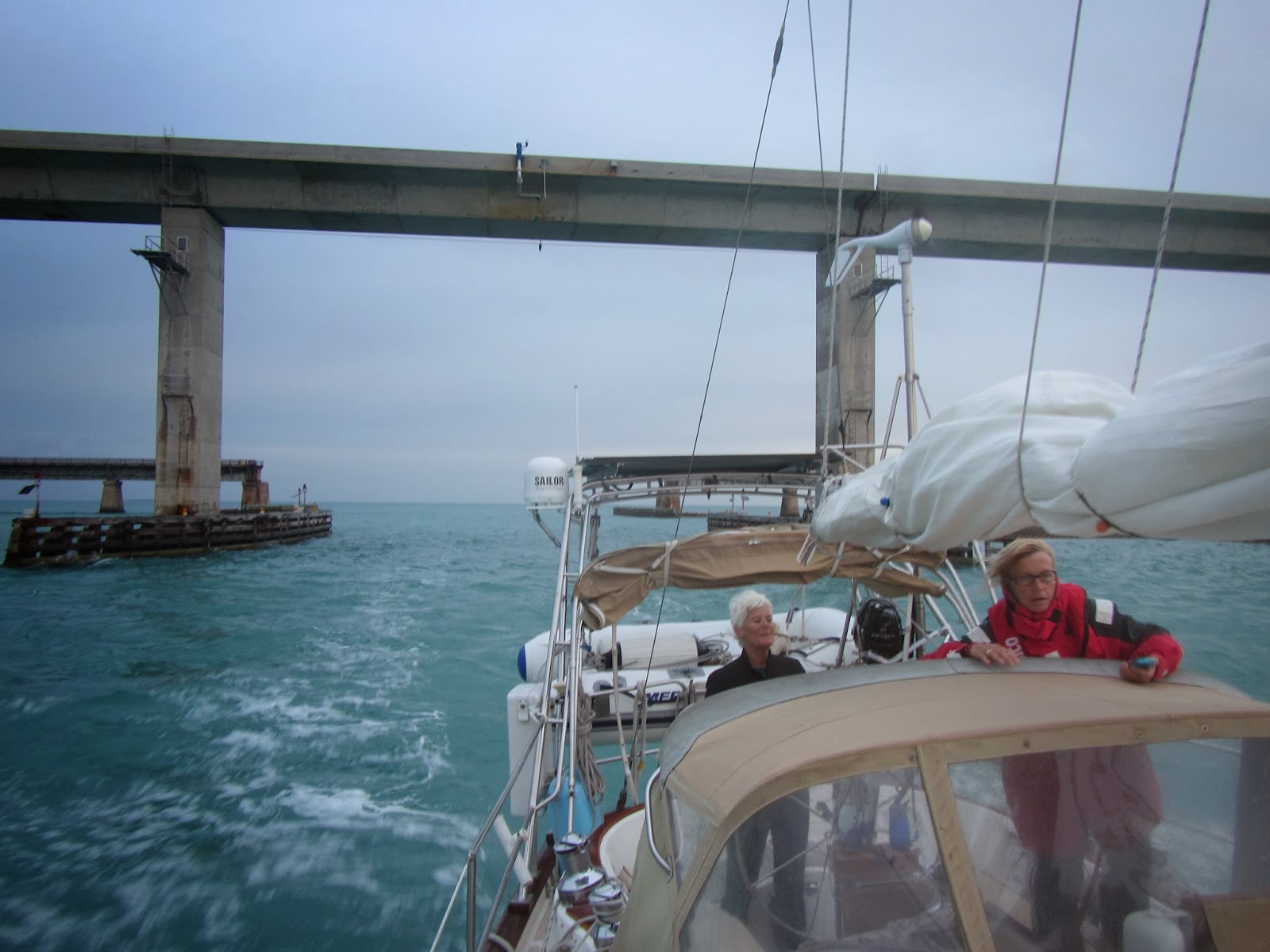
We'd timed our arrival in the Keys for first light so navigated the channels OK -seriously, I've navigated some pretty hairy channels in the Med but nothing like here off the Everglades - half the beacons aren't lit, or are supposed to be and have stopped working, the shoals move around, and there are no straight lines. Its Red Right Returning on the Atlantic side but opposite bouyage on the gulf side of the Keys, so you have to stay alert. Going under the Seven Mile bridge was a heart stopper - 65' clearance with a 58' mast height - looked like we wouldn't fit when it was too late to pull out.
Bottlenose dolphins usually solo or in pairs paid us regular visits night & day, but otherwise visitors on the water were scarce, esp crossing the Bay of Florida where we were 30-40 miles offshore.
Lizzie and Annika have been fantastic crew, and Annika's skills with her $15 iPhone Navionics a blessing.

But it wasn't all fair sailing - going fast and easy across the Bay of Florida, stars all around, I got the fright of my life at 4 am when the emergency bilge alarms went off and shattered my state of reverie.   
Lizzie was just getting up for her watch at 4 and I seriously thought it was her clock alarm -I told her to think about changing her alarm sound as it was too much like my emergency bilge alarm ha ha! 
So, shorten sail to ease the heel on the hull, pull all the stowage out of every orifice until locating the source (a back siphoning into the boat as the stern pressed down on a light sea cockless skin fitting), then fashion a temporary fix and put the boat back together before we had a gust that would spill unstowed gear overboard - all hands were needed on deck, and we did really well. 
Should've added a Jolly Roger
The most alarming part of it was that no-one responded to my Pan Pan calls, on either of the two VHFs, the back up handheld VHF, or the SSB! And no -one answered the phone til 3 hrs later - so if we had been sinking we were on out own -I was trying to find which ports we were passing had haul out facilities in case we had to get her out of the water ASAP - so that has exposed weaknesses in emergency coverage here and questions over my radio signal strengths - so add that to the list! (Actually resolved the VHF issues, just the SSB to work out now)

A few other problems aboard in addition to nav gear and needing more seacocks -the Isotherm thermostat went haywire and froze all our perishables so a lot of food was thrown out (A local whizz kid Alex has confirmed the problem and sourced new ones, plus a back up board for the compressor so that's sorted) This is a power hungry vessel, and as with all cruisers you're constantly managing amp hours. The latest investment is a complete conversion of all the halogen and conventional lighting aboard to LEDs. We've spent time & money proving all the charging systems and battery health and now understand better how to manage Whakaari's complex systems.
And its been fun too -getting to know Boot Key Harbour here in Marathon - a laid back city of boats, made up of cruisers from the four winds, time to talk and socialise, stone crab claws, and Eric Stone boating ballads.

So where next? - On 10 January we depart Boot Key for Key West, down at the tip of Florida, where US1 Highway starts its long run north to Maine, and Ernest Hemingway worked on his classics, where fabulous snorkelling and old forts are to be found, racing regattas about to commence, and our stepping off place for Cuba. We'll be there at least a week no doubt continuing with the refinements we find are needed on the 10 hour sail from here in Marathon - all part of the shakedown!


There's a tide in the affairs of men
which, taken at the flood, leads on to fortune;
Omitted, all the voyage of their life
Is bound in shallows and in miseries
                                                      William 
                                                              Shakespeare


At Drum Circle, Treasure Island


Tampa Bay

"Whakaari" in Letter Art, Yay!


And - have you supported the petition to try and stop the slaughter of dolphins and endangered sharks on Peru's coastline